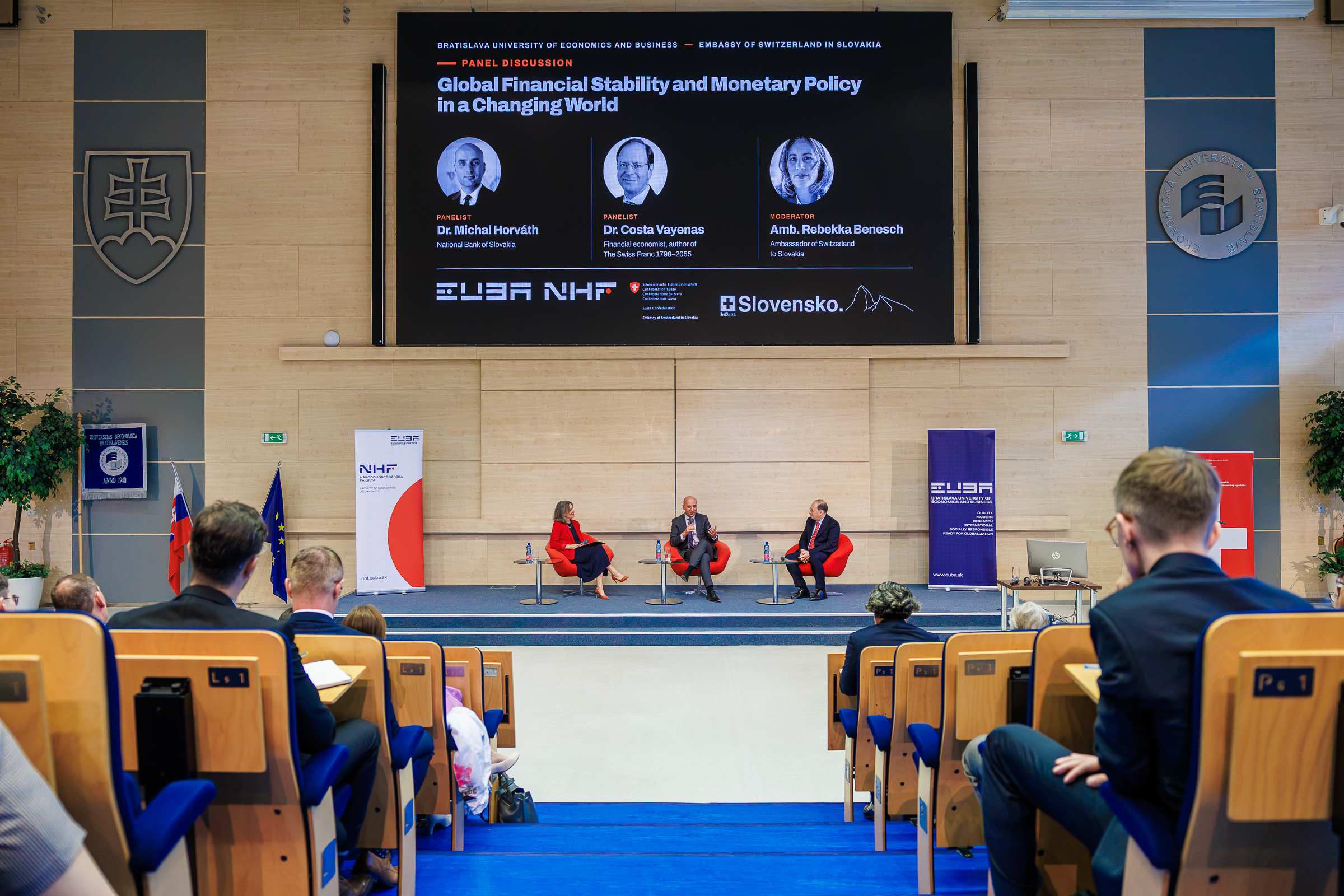
The Faculty of Economics and Finance at the Bratislava University of Economics and Business (EUBA), in cooperation with the Embassy of Switzerland in Slovakia, organised an expert event on 7 October 2026 dedicated to current challenges in global financial stability and monetary policy. The panel discussion, entitled "Global Financial Stability and Monetary Policy in a Changing World", took place in the University Auditorium and brought together students, academics, and representatives from the financial and business sectors.
The event provided a platform for an expert dialogue on the challenges facing central banks and financial systems in an era of growing geopolitical uncertainty, economic fragmentation, and evolving global risks. Particular attention was paid to the importance of monetary stability, central bank independence, and Switzerland's approach to monetary policy and financial system management.
The event was opened by Vice-Dean Ondruška of the Faculty of Economics and Finance. The opening session also featured remarks by Assoc. Prof. Boris Mattoš, Vice-Rector for International Relations at EUBA, and H.E. Rebekka Benesch, Ambassador of Switzerland to Slovakia.
The discussion was inspired by the recently published book The Swiss Franc 1798–2055, authored by Dr. Costa Vayenas, Chief Investment Officer at Genesis Investment Partners AG in Zurich and lecturer at the University of Zurich. In his lecture, Dr. Vayenas explored monetary stability and the Swiss experience in the broader context of global economic developments.
The lecture was followed by a panel discussion featuring Dr. Costa Vayenas and Dr. Michal Horváth, Chief Economist of the National Bank of Slovakia and former Minister of Finance of the Slovak Republic. The discussion was moderated by Ambassador Rebekka Benesch and offered valuable insights into current monetary policy challenges, the role of central banks, and the foundations of long-term financial stability.
The event attracted not only students and members of the academic community but also professionals and representatives from the financial and business sectors. Bringing together academic perspectives and practical experience enriched the discussion and provided an opportunity to connect theoretical knowledge with the challenges of today's economic environment.
The official programme concluded with a lively informal discussion, during which participants had the opportunity to engage directly with the speakers, ask additional questions, and exchange views on current economic and monetary issues. The active participation and interest demonstrated the importance of fostering open dialogue between academia, students, and professionals.
The cooperation between the Faculty of Economics and Finance at EUBA and the Embassy of Switzerland represents another valuable contribution to strengthening Swiss-Slovak relations in education, economic research, and international cooperation. The event also highlighted the importance of connecting academic knowledge with practical expertise in addressing the complex challenges facing the global economy.