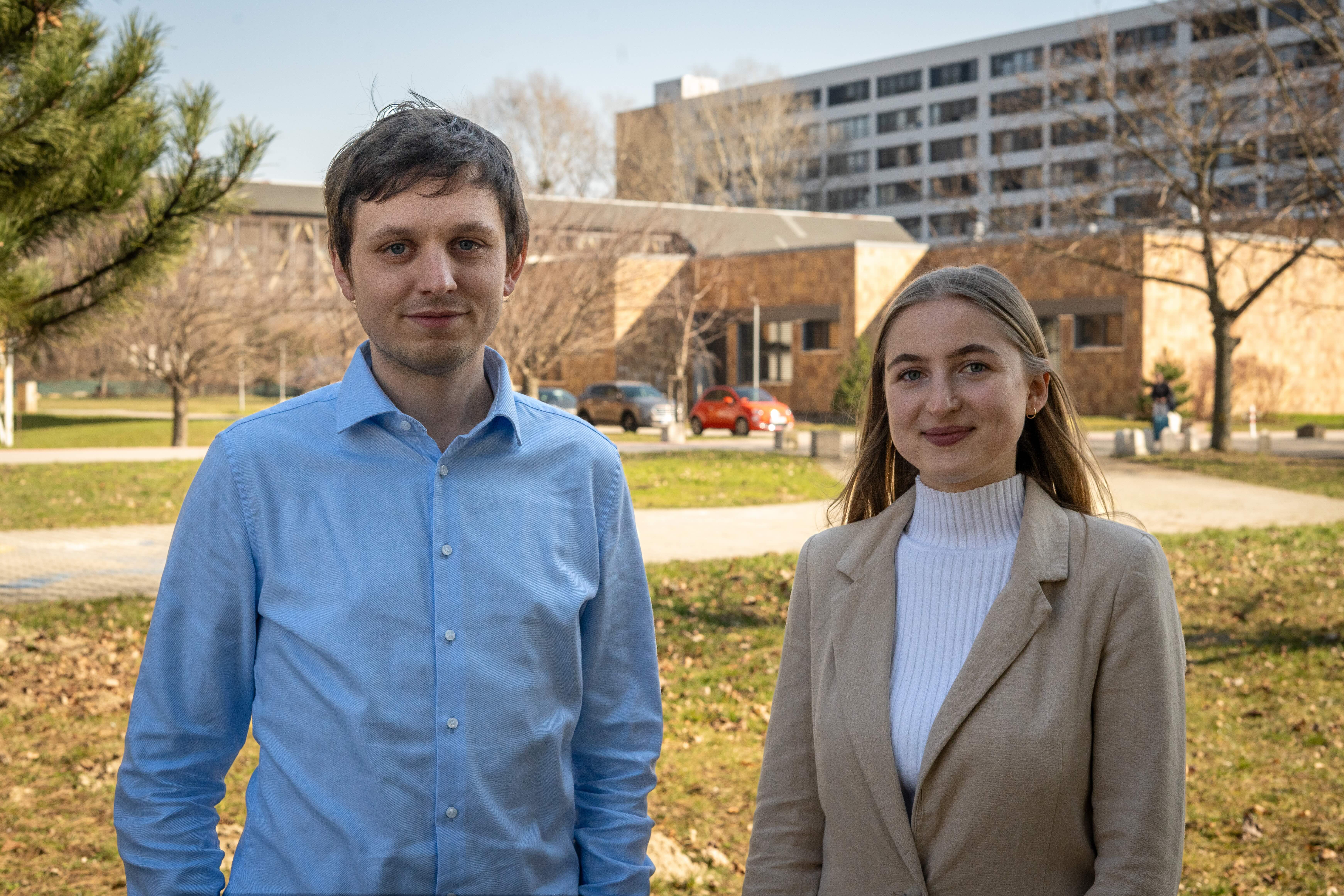
Does public sector employment attract less honest students? That is one way to frame the central research question of a newly published article produced at the Faculty of National Economy (NHF). The study was authored by researcher Richard Kališ, doctoral student Margaréta Pauchlyová (at the photo), and recent graduate Beáta Beňová. We spoke with the authors about how the idea for the research came about, whether public administration really does attract less honest students, and what can be done to help reduce corruption.
What motivated you to study this topic, and why did you choose Slovakia as your case study?
The idea came to me while reading Good Economics for Hard Times by Nobel laureates Banerjee and Duflo, where they mentioned a study on honesty from India. I looked up that study and soon discovered there were others like it — with the most well-known probably being from Denmark. When I compared the results from India and Denmark, I found them striking. In India, a country with a significant level of corruption, public administration tended to attract less honest students; in Denmark, one of the least corrupt countries in the world, it was exactly the opposite. I found that fascinating, but I had no idea what the picture looked like in Slovakia. That is what makes our context so interesting — we are a relatively wealthy country, yet corruption exists here and, unfortunately, shows little sign of declining. So I decided to try replicating this research as a thesis project, which Beáta signed up for — together we ran the experiment and successfully defended the dissertation. Later, when we saw how interesting our results were, we brought Margaréta on board. Unlike the two of us, she has a longer background in experimental economics, and she helped us transform the thesis into a final publication in the journal Post-Communist Economies.
How did you actually measure dishonesty in students — after all, you can't catch someone lying red-handed?
The research was conducted through a questionnaire in which we asked NHF students about their professional preferences — giving us a picture of where they want to work. We also asked them to roll a virtual die, but before each individual roll they had to guess the number it would land on. If they guessed correctly, they received a small financial reward. Since we had no way of verifying their guesses and could only see the outcome — whether they got it right or not — there was an incentive to cheat. We detected dishonesty by knowing the probability with which they should have been able to guess the rolls correctly. If the number of correct answers significantly exceeded that expected value, it is very likely that they inflated their results.
Your results show that in Slovakia, public administration tends to attract less honest students. Should society be concerned?
To some extent yes, as it may contribute to the persistence of corruption in society — but it is more complicated than that. Our experiment did show that students who prefer public administration or political work as their future career cheated somewhat more often. At the same time, we found that students who were willing to donate a larger share of their earnings to charity were considerably more honest — and those who donated everything they had earned cheated hardly at all. Pro-social behaviour therefore goes a long way toward offsetting dishonesty. It is also worth noting that the public sector is a very broad concept. Some areas within it may well attract people with strong pro-social values and a genuine commitment to integrity.
What practical recommendations follow from your research — what should the state or public institutions specifically change about how they recruit employees?
One of our secondary findings is that students who cheated more often also tended to say that higher wages were important to them when choosing a career. This matters because it is often argued that high salaries deter corruption, since dishonesty simply does not pay for people who are already well compensated. Our findings suggest that may not always be the case. Rather than relying on high pay as a tool against corruption, greater emphasis could be placed on assessing the personal profile of candidates. Equally important is addressing how corruption is perceived. If public administration carries the label of a corrupt environment — whether or not that is actually true — it will naturally attract less honest individuals who see it as a place where their predispositions can be put to use. Awards such as Biela vrana (White Crow) or Civil Servant of the Year therefore help build a far more positive image of public service, and their impact may be greater than it first appears.