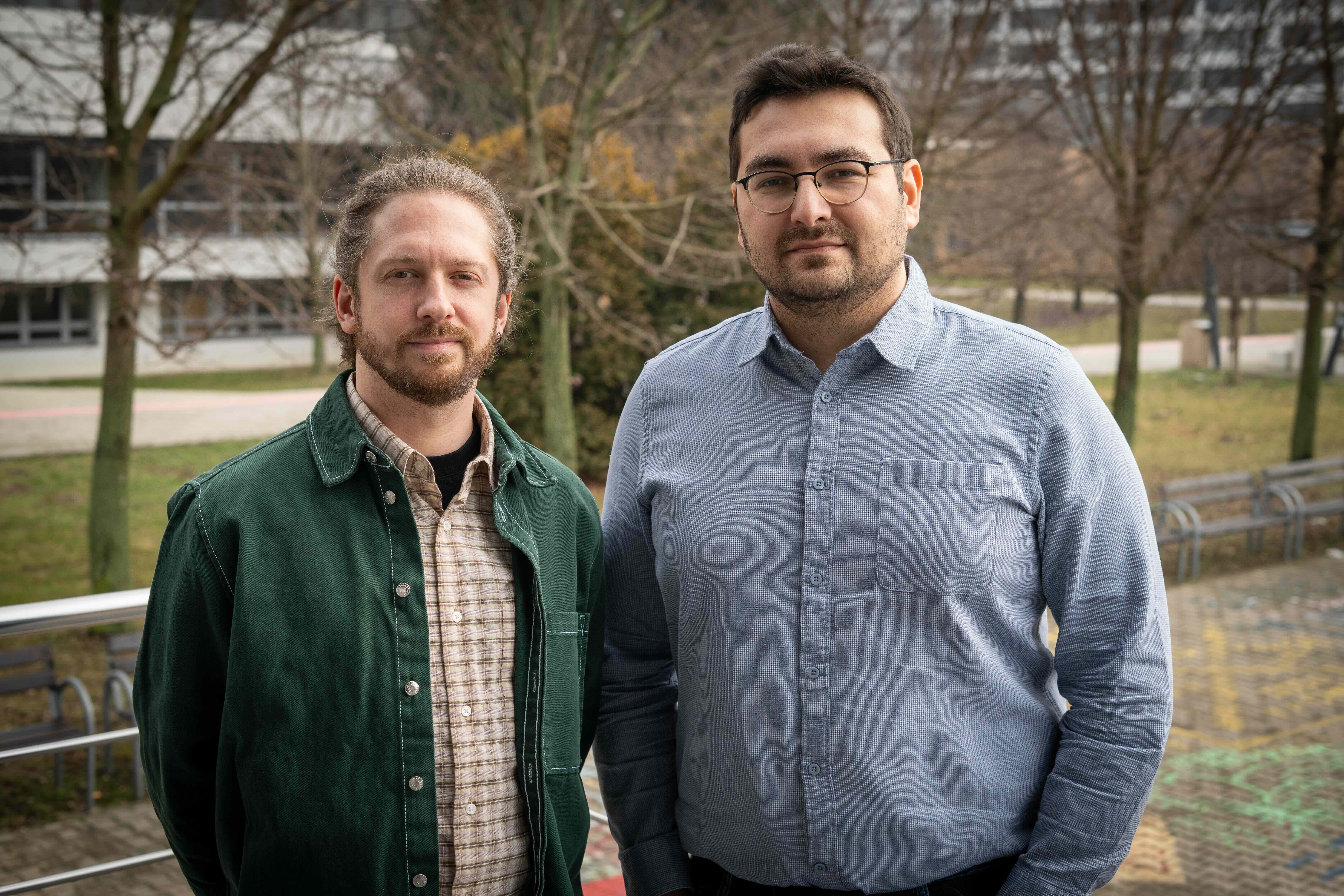
Francesco Roncone (left) and Kaan Ragip Erdemli (rigth) are new members of the Faculty of Economics and Business, joining us from very different academic and professional backgrounds. Their arrival strengthens the international dimension of our faculty. Francesco teaches Labour Economics, while Kaan lectures Quantitative Methods in Economics at the bachelor’s level and Analysis of Market Structures at the master’s level.
We sat down with both of them to talk about their academic journeys, research motivations, and first impressions of the faculty.
Let me start at the beginning. Could you both tell us a bit about yourselves and what brought you to the Faculty of Economics and Business?
Francesco: First of all, I am very happy to be here at the Bratislava University of Economics and Business and to be part of such a great research team surrounded by passionate economists. The path that brought me here was quite interesting, but also logical in hindsight.
About a year and a half ago, during a conference on technology and automation in Gdańsk, I met one of the members of the faculty staff – Tomáš Oleš. We immediately connected through our common research interests and soon started working on a new project on AI and local labor markets. Through this connection, I visited your faculty last year and also participated in the Slovak Economic Association Meeting in Nitra. As it turned out, there was a very good match in terms of research focus as well as broader career development opportunities, which eventually led me to join the EUBA team.
Before coming here, I was a postdoctoral research fellow at the University of Bologna in Italy, and I completed my PhD at the University of Adelaide in Australia. One of the most valuable aspects of my academic journey so far has been the opportunity to experience different countries, cultures, and research environments.
Kaan: I hold two master’s degrees in economics: one from Sabancı University in Turkey and another from CEMFI in Spain. After completing my studies in Spain, I moved to the University of Barcelona to pursue a PhD in Economics. During my PhD, I had the opportunity to visit DICE at the University of Düsseldorf and the University of Vienna. Over the past few years, I have met with several faculty members at EUBA and came to appreciate it as a place where I could continue my academic career. When I learned of a position at EUBA that aligns with my profile, I applied with great enthusiasm.
Let’s turn to your research. What has been your main field of specialization so far? And have your research interests evolved since you joined the faculty?
Kaan: My main field is empirical industrial organization and its intersection with environmental economics. Currently, I am working on several projects related to information frictions in consumer markets and emission policies targeting private vehicles. In most of my work, I use so-called structural econometric methods, which are standard in empirical industrial organization.
My research interests are gradually expanding toward the field of choice modeling. I see many potential applications of choice models in labor economics and transport economics, which creates opportunities for collaboration both within my department and with researchers in other departments at the university.
Francesco: My main research field at the moment is the impact of technological change—particularly AI and automation—on the future of work. We are living in very interesting times to study these developments, given the accelerating pace of technological change and their far-reaching consequences for labor markets.
At the same time, I am quite versatile in my research and enjoy working on a broader range of topics within labor economics and across disciplines. For example, I am currently involved in different projects on occupational mobility and precarious working conditions, the polarization of the female labor market, and the reintegration of former convicts into the labor market. For me personally, the research question always comes first, with the aim of producing work that has real-world relevance and impact. Working at the faculty has further strengthened this focus, especially through collaborations and discussions with colleagues.
What motivates you most as researchers? What drives your interest in continuing academic work?
Francesco: My main intrinsic motivation is to contribute meaningfully to existing research and to push the boundaries of how we understand economic relationships. I sometimes feel that research has become a bit too streamlined and risks losing sight of the bigger picture, so challenging established perspectives and crossing boundaries is an important motivation for me.
At the same time, I am still at an early stage of my research career, which means I am actively exploring different areas and looking for ways to connect disciplines. For example, in a new project I study the impact of gender-biased technological change on female political polarization.
Most importantly, research should be enjoyable. I see this as essential for maintaining curiosity and motivation, which is key to pursuing ambitious research goals in the long run.
Kaan: During my master’s studies at CEMFI, I realized that I enjoy modeling the behavior of economic agents and employing structural econometrics to analyze economically relevant and difficult-to-answer questions. Although I am much more experienced now, each new research project is unique and introduces new challenges in terms of modeling and estimation strategies. I think that new challenges and the continuous learning process are my main motivations.
You have both been here for a few months now. How do you see the faculty and the team so far? And what differences stand out compared to your previous academic environments?
Kaan: The academics at the faculty are approachable, kind, and supportive. Having a healthy work environment is very important to me, and I am very happy to be part of the faculty.
Compared to my previous academic environments, the most significant differences are related to the accessibility of resources. Specifically, I am surprised that here we have much easier access to computational resources such as supercomputers, and that interesting data are much more accessible through government units.
Francesco: The faculty and the team are simply fantastic. Even though I have only been here for a short time, I already see a lot of potential. What really stands out is the amount of effort everyone is putting in—not only individually, but especially collectively—to further develop the faculty.
There is a strong sense of shared purpose and genuine passion to enhance the standing of both the faculty and the university more broadly. This is reflected in close collaborations, frequent seminars, and teaching that is closely linked to state-of-the-art research in economics.
Compared to the University of Bologna, where I worked previously, the most striking difference is the more personal environment. This is largely due to the smaller structure of the faculties here. Bologna is a much larger and more diverse university in terms of research directions, but it can also feel more anonymous.
Photo: Filip Gono