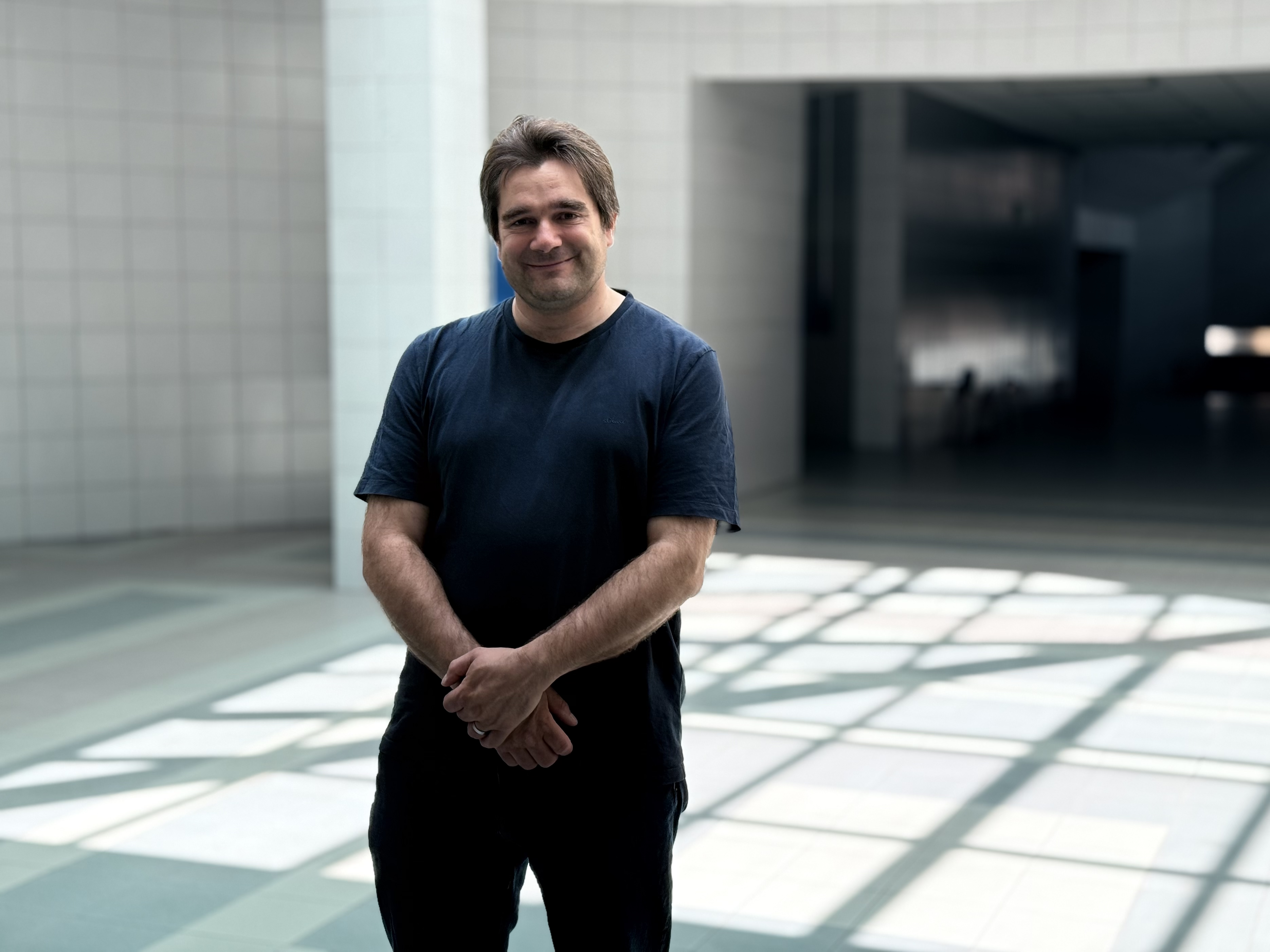
Professor Klaus Prettner has been an affiliated researcher at the University of Economics in Bratislava, Faculty of Economics and Finance, for the past two years, contributing to the project “Stagnant Wages in the Face of Rising Labour Productivity: The Role of Automation Technologies.” As the project is now concluding, we spoke with Professor Prettner about his perspective on automation and its impact on the labour market, the key research findings, and the future challenges that merit further investigation.
Dear Professor, could you briefly introduce the project you have been working on over the past two years? Why is this topic particularly relevant today? What are the main challenges that automation poses for the labour market, as well as for other sectors and the economy as a whole?
The project starts from a very simple but, in my view, highly important observation: in many advanced economies, labor productivity has continued to increase, while wages for many workers have not kept pace. This development is puzzling from the perspective of standard economic theory, according to which higher productivity should translate into higher wages at some point. Our project therefore asks whether automation technologies, in particular, industrial robots, can help explain this growing wedge between productivity and wages.
The topic is especially relevant today because automation is already part of production processes in manufacturing, logistics, transport, healthcare, and increasingly also in services with AI increasingly affecting cognitive work. At the same time, the public debate often focuses on the question of whether robots and AI will “destroy jobs.” This is, of course, an important question, but it is not the only one. Even when employment does not collapse, automation can still change the distribution of income. It can affect who benefits from productivity growth, whether workers participate sufficiently in the gains from technological progress, and how the returns to production are divided between labor and capital. On the other hand, automation has enormous potential. It can raise productivity, reduce the need for humans to perform physically demanding or unhealthy tasks, help firms remain competitive, and even mitigate some of the economic challenges associated with population aging and shrinking labor forces. Therefore, I do not think that the right response is to slow down technological progress or to romanticize the pre-automation economy but to try to ensure that the benefits of automation are reinforced by policy measures and the negative consequences are contained as far as possible.
What are the main research outcomes of the project conducted at the faculty over the last two years? Are there any policy recommendations resulting from your project?
Together with Tomáš Oleš, Martin Lábaj, Erika Majzlíková, and Dávid Hojdan at the University of Economics in Bratislava, we have studied the question posed above whether automation technologies, in particular, industrial robots, can help explain the growing wedge between productivity and wages. We do this from both theoretical and empirical angles in the article “Robots and the Wedge Between Wages and Productivity: A European Analysis”. On the theoretical side, we develop a framework in which robots substitute for routine labor. In such a setting, automation can increase output per worker because production becomes more efficient. At the same time, however, workers who are good substitutes for robots may struggle to compete with them. Thus, robots would simultaneously raise productivity and put downward pressure on wages. It could therefore be the explanation for the emerging and increasing gap between labor productivity and wages. We test the presence of this mechanism with European country-sector data from 1995 to 2020. The evidence suggests that robot adoption is indeed associated with a widening gap between labor productivity and wages, particularly in economically important sectors. Importantly, we do not only document descriptive correlations, but also try to address endogeneity concerns by exploiting robot adoption trends in technologically advanced economies outside Europe as an external source of variation.
The policy challenge is to ensure that broad segments of society benefit from automation. This requires investment in education and (re-)training, but education alone is unlikely to be a silver bullet. We also need tax systems that remain viable when the labor income share declines and social security systems that are robust to changes in the structure of employment. It is important to prevent a situation in which large parts of the population feel disconnected from economic development. One of the reasons is that this may lead to anger, societal division, and a surge of populism in politics with potentially severe negative economic consequences.
Currently, the impact of artificial intelligence is being discussed even more intensively than automation. Based on your research and experience, should we expect similar effects on the labour market and other sectors from AI as we have seen with automation, or is this a fundamentally different development?
AI represents a specific form of automation, mainly the automation of cognitive tasks. While industrial robots are well-suited to automate routine manual labor, AI makes inroads in automating cognitive tasks that have been seen as unautomatable just a few years ago. As such, AI has different effects on the wage distribution than industrial robots because it mainly substitutes for tasks often perfomed by high-skilled workers. However, in terms of the shift of income away from labor and toward capital the effect is very much comparable to that of industrial robots. We show this in another article that we wrote within the project with Antonio Minniti and Francesco Venturini „AI innovation and the labor share in European regions“, which has been published in the European Economic Review. Overall, our results show that industrial robots and AI have comparable effects when it comes to productivity increases and inequality of income between the production factors capital and labor but they are fundamentally different when it comes to inequality between different types of workers.
What are your research plans for the coming period? Which open questions or areas do you consider most important for further investigation?
First, I think we need to move beyond the rather narrow questions for which outcomes are easy to measure. Employment effects are important, of course, but they are only one part of the story. Even if workers remain employed, automation may affect job quality, perceptions of meaning at work, career prospects, and mental health in general. In addition, children are increasingly being exposed to AI-generated content very early in their lives, deepfakes spread on social media and erode trust and social cohesion, and education systems are disrupted with the availability of AI. It is very important to get a solid understanding of these effects of AI as well and of strategies to cope with them.
Second, also at the macro level, the rise of artificial intelligence raises new questions that go much beyond its economic effects. There is the geostrategic dimension of the race toward artificial general intelligence (AGI), which outperforms humans in all relevant tasks. Whichever country is first in this race will have large advantages in geopolitical terms. Then there is the environmental dimension. AI requires vast amounts of electricity to be trained and operated. This could not only lead to increasing prices for the broader population, but also to severe environmental damages. Furthermore, we understand too little about AI risks. This starts with the use of AI or scams and for writing malicious software (Trojans, etc), but it does not stop there. Some are afraid that AI could be used to create biological weapons rather easily. In the hands of terrorists, this is a huge risk and could lead to unprecedented terror-related damages to the lives of many. And finally, the alignment problem is not yet solved, that is, to ensure that an AGI that outperforms humans in all relevant tasks remains committed to improve the lives of humans. Unfortunately, that question is much more difficult to solve than we would like to have. Research in all these areas is urgently needed to understand and to shape the transition through which we are currently living. I am confident that the ties between the economic universities of Bratislava and Vienna have been strengthened enormously by this project such that future research in all these areas will benefit strongly from them.
Funded by Recovery and Resilience Plan for Slovakia -- ProWageAut No.~09I03-03-V04-00516 Fellowships for excellent researchers R2-R4